Industry updates & technical guides about clear plastic boxes and UV printing. Learn packaging produ
You have likely encountered this before: a package whose logo catches the light as if freshly lifted from water, while the surrounding background sits quietly in shadow, reflecting almost nothing. This selective retention of light is not a printing accident. It is a carefully calibrated post-press operation known as Spot UV.
The working principle is deceptively simple, yet remarkably finicky. A transparent UV-curable varnish is confined to designated zones, then bombarded with ultraviolet light—solidifying from liquid to solid in fractions of a second. The treated patches suddenly acquire a glass-like ability to refract; the adjacent, untreated areas remain subdued in their matte or laminated state. On one flat surface, brightness and darkness, prominence and recession, extroversion and restraint, all coexist.
But here is the cunning part: Spot UV is never about making things "brighter." If pure brilliance were the goal, full-cover UV would suffice—cheaper, faster, fewer steps. The true intention behind Spot UV is to manufacture contrast. Contrast implies relationship; relationship invites reading. The consumer's gaze, previously drifting across the shelf, is now forced to pause at a specific point. That point is usually a brand name, a category descriptor, or a carefully chosen fragment of an illustration.
The tactile dimension deserves equal attention. Once cured, the varnish forms a micrometer-level relief—barely visible but unmistakably perceptible when fingertips trace across it. That boundary between smooth and textured, glossy and dead-flat, is in some ways more aggressive than visual contrast, because it does not just ask you to look. It asks you to touch.
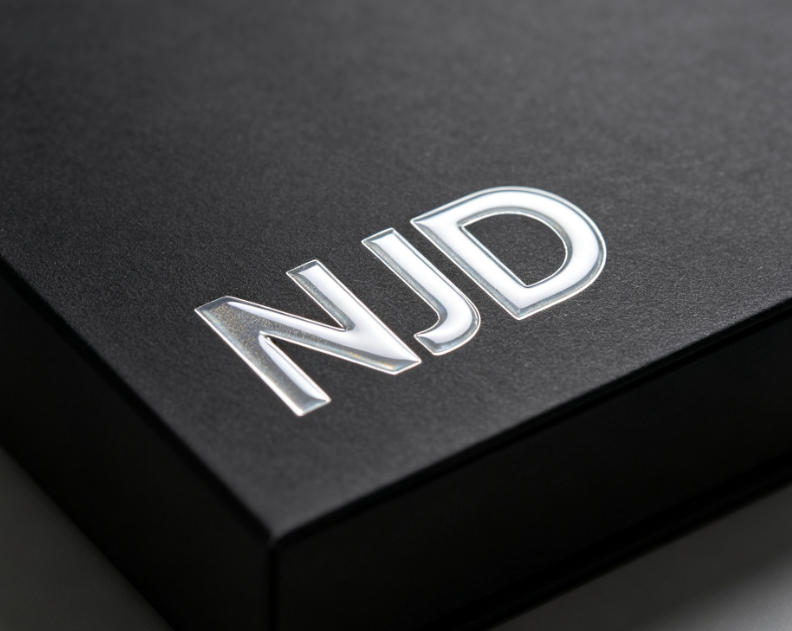
Before adding Spot UV to a project, three considerations merit upfront thinking. They are not complicated, but they are often overlooked.
First, is the substrate cooperating? Spot UV's ideal partner is never high-gloss coated paper. It is matte-laminated board or any stock that has been deliberately dulled. The matte background absorbs light; the UV areas reflect it—contrast emerges from that opposition. If the substrate is already glossy, the game of contrast loses its playing field from the start.
Second, does the design breathe? Spot UV dislikes congestion. When a surface is already crammed with illustrations, typefaces, and color blocks, adding a varnish layer only induces visual chaos. Effective Spot UV tends to appear on layouts with generous white space—the simpler the design, the more clearly the UV zones can be perceived.
Third, is precision overrated? It is common in the industry to chase ultra-fine UV lines, assuming thinner equates to more sophisticated craftsmanship. In reality, lines narrower than 0.2 mm are prone to breakage or bleed during high-volume production. Rather than challenging the laws of physics, it is wiser to accept the process's natural limits and reserve UV for areas with ample real estate.
If the discussion so far remains within the realm of "visibility," Blind Spot UV ventures into another logic altogether. It applies varnish to completely blank areas—where no printing ink exists—creating a texture that is nearly invisible. Only under raking light or at a specific angle do these patterns emerge, like a watermark quietly surfacing.
The risk is obvious: consumers might never notice it. But the reward is equally distinctive—when discovered, that sudden "aha" moment translates swiftly into trust in the brand's attention to detail. Blind Spot UV does not serve instant recognition. It serves serendipity. In an era where packaging design grows louder by the day, this quiet, almost secretive gesture stands out precisely by not shouting.
Spot UV is not an essential process. It is picky, cost-incurring, and demanding on design. But that is precisely why, when used well, the signal it sends is not "we used UV." It is "we thought carefully about every detail." And that, perhaps, is what a brand truly needs.